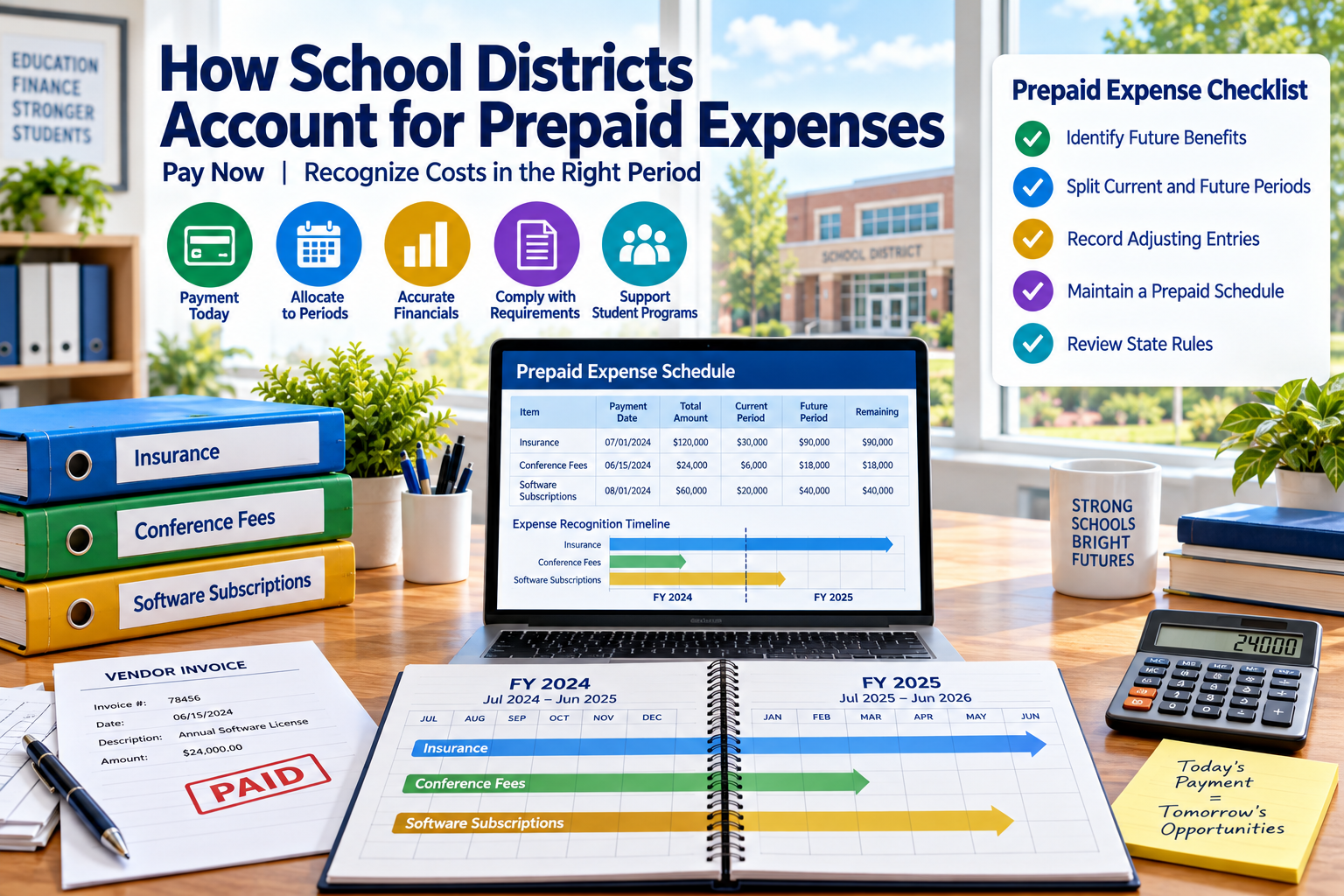
Paying an invoice is not always the same as recognizing the full cost. A school district may pay an annual insurance premium in May, register an employee for an August conference, or renew a service before the next fiscal year begins. Cash has left the district, but some or all of the benefit belongs to a future reporting period.
That timing difference is the reason prepaid items require attention during year-end close. If the district records every advance payment as a current-year expenditure without considering its reporting framework and state requirements, expenditures may be overstated in one year and understated in the next. If staff defer too much, the district may overstate assets or misclassify restricted resources.
The correct treatment is not identical in every state or reporting layer. District policy should follow the applicable state accounting manual, chart of accounts, materiality policy, and auditor guidance. The workflow below provides a practical way to make and document that determination.
What Is a Prepaid Expense in School District Accounting?
A prepaid item is a payment made before the district receives the related benefit. The National Center for Education Statistics describes prepaid items as expenditures or expenses paid for benefits not yet received and gives prepaid rent, prepaid interest, and unexpired insurance premiums as examples in its account classification guidance.
Common K–12 examples include:
- Insurance coverage extending beyond June 30
- Conference registration for an event in the next fiscal year
- Rent paid in advance
- Maintenance or support agreements covering future months
- Software access beginning in a later period
- Multi-period subscriptions, subject to applicable lease or subscription guidance
A deposit is not automatically a prepaid expense. A refundable security deposit may remain a deposit or receivable because it is expected to be returned rather than consumed. Likewise, inventory, retainage, and advances to other parties can require different accounts. The finance team should classify the substance of the transaction, not rely only on the vendor’s invoice label.
Start With the Reporting Framework, Not the Invoice Date
The first practical question is not “When did we pay?” It is “Which financial statement and accounting policy are we preparing?”
Governmental funds generally use the current financial resources measurement focus and modified accrual accounting. Government-wide statements use the economic resources measurement focus and accrual accounting. State rules may also prescribe whether a governmental fund uses a consumption method or a purchases method for prepaid items.
Under a consumption approach, the district initially reports the future portion as an asset and recognizes expenditure or expense as the benefit is used. Under a purchases approach, the governmental fund recognizes the outflow when the item is purchased. For example, North Carolina’s statewide policy directs governmental funds to use the purchases method while reporting prepaid items as assets in government-wide, proprietary, and fiduciary statements. That policy illustrates why a district should not copy an entry from another state without checking its own requirements.
California provides a different school-specific example. Procedure 420 of the California School Accounting Manual demonstrates recording future benefits in a prepaid expenditures asset account, maintaining a schedule by year, and charging the applicable amount to expenditure when the new year begins.
The lesson is straightforward: document the rule that applies to each reporting layer before posting the adjustment.
A Practical Year-End Example
Assume a district with a June 30 fiscal year pays a $24,000 insurance premium on May 1. The policy covers May 1 through April 30, or 12 months at $2,000 per month.
- Benefit received in the current fiscal year: May and June, or 2 months
- Current-year cost: 2 × $2,000 = $4,000
- Benefit belonging to the next fiscal year: 10 months
- Prepaid amount at June 30: 10 × $2,000 = $20,000
If the district’s applicable policy uses the consumption method, the May 1 entry could be:
| Account | Debit | Credit |
|---|---|---|
| Prepaid insurance | $24,000 | — |
| Cash/accounts payable | — | $24,000 |
At June 30, the district recognizes the portion consumed in May and June:
| Account | Debit | Credit |
|---|---|---|
| Insurance expenditure or expense | $4,000 | — |
| Prepaid insurance | — | $4,000 |
The remaining $20,000 stays in the prepaid account at year-end. Beginning in July, the district can recognize $2,000 each month, or use another documented allocation interval permitted by policy.
Some systems record the full payment to expenditure first and reclassify the unexpired portion at year-end. In that workflow, the adjusting entry would debit prepaid insurance for $20,000 and credit insurance expenditure for $20,000. The ending balances are the same, but the audit trail should clearly show how the calculation was made.
Build a Prepaid Schedule That an Auditor Can Reperform
A general ledger balance alone does not explain what the district bought or how the remaining amount was calculated. Maintain a subsidiary prepaid schedule with at least these fields:
- Vendor and contract or policy number
- Description of the benefit
- Purchase order and invoice number
- Fund, function, object, program, and location codes
- Payment date and total payment
- Service start and end dates
- Amount applicable to the current fiscal year
- Amount carried into each future fiscal year
- Monthly or annual recognition amount
- Funding source and restriction, if any
- Preparer and reviewer approval
- Link to the invoice, contract, and proof of payment
The schedule total should reconcile to the prepaid asset in the general ledger. Each item should also reconcile to its supporting documentation. California’s manual recommends preparing a schedule when the original disbursement is made and carrying forward only the portion that remains applicable to later years. That is more reliable than reconstructing dates months after the invoice was paid. A consistent coding structure also matters; see this related explanation of how a school district chart of accounts organizes financial data.
Use a Consistent Decision Process
1. Confirm that a future benefit exists
Identify the service period or event date. If the district received the entire benefit before year-end, there may be nothing to defer even if the vendor describes the payment as “annual.”
2. Check state and district policy
Determine whether the purchases or consumption method applies. Confirm any materiality threshold and whether the rule differs between fund statements and government-wide statements.
3. Separate current and future periods
Use contract dates rather than payment dates. For uneven services, a straight-line monthly allocation may not reflect actual consumption. Document why the allocation method is reasonable.
4. Confirm the funding source
Restricted grants require extra care. A cost paid early is not necessarily allowable in the current grant period. The California manual, for example, warns that certain categorical-program prepayments can create fund-balance presentation problems and provides a specific process for its reporting environment. Consult the award terms and state guidance before charging a prepaid amount to restricted resources.
5. Post and review the entry
Use separate preparation and approval when practical. The reviewer should verify the dates, calculation, accounts, funding source, and supporting documents—not merely approve the journal entry total.
6. Reverse or amortize on schedule
Assign responsibility for releasing the prepaid amount. An asset left on the ledger after the benefit has been received is just as inaccurate as expensing the entire payment too early.
Do Not Treat Every Software Prepayment as an Ordinary Prepaid Item
Technology contracts deserve a separate review. A multi-year software arrangement may meet the definition of a subscription-based information technology arrangement rather than a routine short-term prepaid service. Payment timing does not by itself determine the accounting model.
The Arizona Auditor General’s school district guidance notes that fully prepaying a qualifying subscription for a discount does not make it cease to be a subscription-based IT arrangement. Its guidance distinguishes the governmental fund treatment from the government-wide recognition and amortization of a right-to-use subscription asset. Districts should review applicable GASB guidance and state instructions before putting a multi-year software payment into an ordinary prepaid account.
Internal Controls That Prevent Common Errors
The best control is to identify potential prepaids before the year-end rush. Accounts payable can flag invoices containing future service dates, while procurement can require contract start and end dates in the purchase requisition. Prepaid review should be assigned alongside the other reconciliations described in the district’s fiscal year-end close process, rather than treated as an isolated adjustment.
Useful controls include:
- Run a report of payments made in the final 60–90 days of the fiscal year
- Search invoice descriptions for terms such as annual, renewal, coverage, subscription, registration, and service period
- Require service dates on purchase orders for time-based contracts
- Establish and document a materiality threshold approved by management
- Reconcile the prepaid schedule to the general ledger every month during close
- Review old balances and investigate items that have not changed
- Restrict manual journal-entry access and retain electronic approvals
- Confirm that the same cost was not also accrued or encumbered
- Review restricted-fund allowability separately from financial statement timing
Common Mistakes to Watch For
Using the invoice date as the service date. An invoice dated June 15 may cover services beginning July 1.
Applying one state’s method everywhere. State charts of accounts and reporting instructions can differ. The North Carolina and California examples above demonstrate why local guidance matters.
Ignoring fund-balance classification. When a governmental fund reports a prepaid asset under the applicable consumption method, the associated amount may need to be reflected as nonspendable fund balance. Verify the presentation requirements that apply to the district.
Leaving expired items on the balance sheet. A prepaid schedule needs release dates and assigned ownership.
Treating a refundable deposit as an expense. Determine whether the district is purchasing a future benefit or holding a recoverable claim.
Automatically classifying multi-year software as prepaid expense. Screen the contract for subscription, lease, and intangible right-to-use implications.
Year-End Prepaid Expense Checklist
Before closing the fiscal year, confirm that the district has:
- Identified material payments covering future periods.
- Verified service dates against contracts and invoices.
- Applied the state-prescribed accounting method.
- Distinguished fund-level and government-wide treatment.
- Reviewed grant and restricted-resource allowability.
- Evaluated software agreements separately when necessary.
- Reconciled the detailed schedule to the general ledger.
- Recorded current-year consumption and future-year balances correctly.
- Scheduled the next-period release or amortization entries.
- Retained enough documentation for an independent reviewer to reproduce the calculation.
Final Takeaway
Prepaid expense accounting is fundamentally a timing and documentation exercise. The district must connect a cash payment to the period in which the benefit is received, then apply the method required by its reporting framework and state guidance.
A strong process does more than produce a year-end journal entry. It captures service dates when the purchase begins, separates restricted funding questions from financial reporting questions, maintains a schedule that reconciles to the ledger, and assigns responsibility for recognizing the cost in the correct period. Those steps give finance staff, auditors, and governing boards a clearer view of what the district has already consumed and what it has paid for but not yet received.