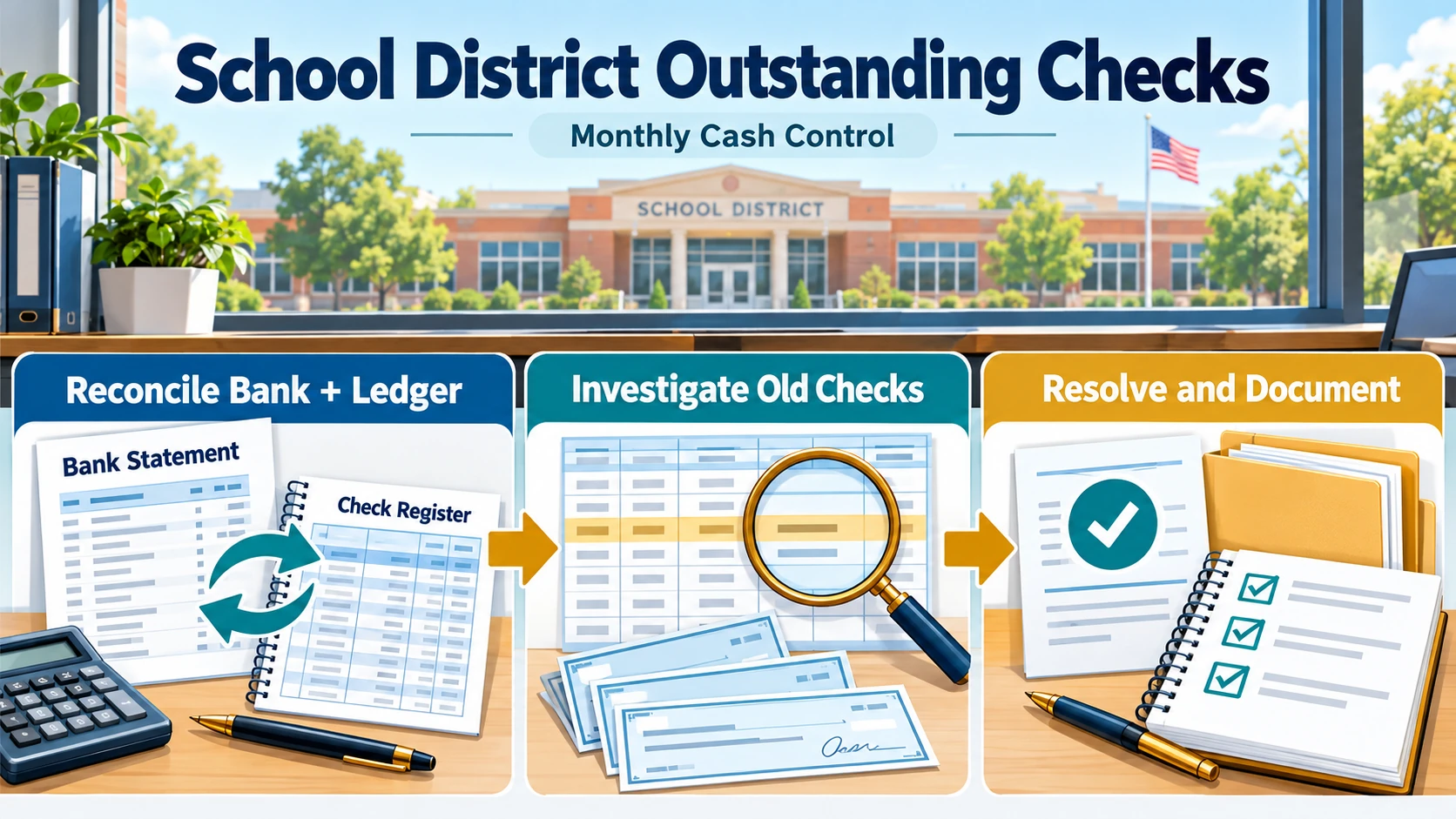
An outstanding check is easy to overlook because the payment already appears in the school district’s ledger. The bank has not cleared it, however, and the check can sit on a bank reconciliation for months. Some are normal timing differences. Others are duplicate payments, returned mail, an incorrect payee, a check that should be replaced, or property that eventually must be reported under state unclaimed-property rules. A reliable monthly close separates those cases before the outstanding-check list becomes a parking lot.
This guide is for U.S. K–12 district business offices reconciling vendor and payroll disbursement accounts. It explains how to tie the bank and ledger, age unresolved checks, investigate exceptions, and document a reissue or remittance. State rules, bank agreements, and district policies determine the exact deadlines and approvals. The broader district cash-management process should identify every account that needs this control.
Understand what an outstanding check does to the reconciliation
When the district issues a valid check, it normally records the disbursement in its books. Until the payee deposits the check and the bank pays it, the bank statement still includes that cash. The outstanding check is therefore subtracted from the bank side of the reconciliation. It is not a second current-month expense, and it should not be removed from the list merely because staff want the adjusted balances to agree.
The National Center for Education Statistics (NCES) school accounting guide names bank reconciliation as an independent check of accounting records against assets. Its internal-control discussion also emphasizes the separation of incompatible duties. The current Texas Education Agency (TEA) Financial Accountability System Resource Guide, Version 20 lists bank reconciliation testing among suggested cash audit procedures. These sources support a routine, reviewable reconciliation rather than an unexplained spreadsheet balance.
Start with the complete bank statement, the general ledger cash account, and the check and deposit registers for the same account and month-end date. Match cleared checks and electronic payments by identifier, amount, and date. Identify deposits in transit and checks still outstanding. Record bank-originated items such as fees or interest in the ledger when appropriate, and investigate transactions present on one side only. Finish when the adjusted bank balance equals the adjusted book balance, then tie the book amount to the general ledger control account.
Use a numerical reconciliation that explains the difference
Suppose the district’s June bank statement shows $260,400. A $18,000 deposit made near month-end appears in the district’s books but reaches the bank in July. Checks totaling $30,900 were issued and recorded before June 30 but have not cleared. The adjusted bank balance is $247,500: $260,400 plus $18,000 less $30,900.
The ledger initially shows $247,550. The bank statement includes a $50 service fee that has not been recorded. After the district posts and reviews that fee, adjusted book cash is also $247,500. The reconciliation now ties. A $2,400 vendor check issued months earlier is part of the $30,900 outstanding total. It did not create the $50 difference and should remain on the supported outstanding list while staff investigate it. If it clears next month, the bank side will reflect payment and the item will leave the outstanding list without another expenditure entry.
Keep the bank statement, bank activity export, ledger detail, reconciliation, the $50 adjustment support, and the dated outstanding-item listing together. The arithmetic alone does not establish that every old check is valid. The aging review addresses that separate question.
Age the check list and investigate exceptions
Produce an open-check report with check number, issue date, payee, amount, bank account, fund or program, original voucher, mailing or delivery status, and last action. Group by age under the district’s policy and flag unusual items: large checks, checks that have survived several reconciliations, payroll checks to former employees, checks mailed to returned addresses, duplicate numbers, and items whose amounts disagree with the bank or vendor record. A locally chosen review threshold can prioritize work, but it is not a universal legal definition of abandonment.
For each flagged check, first verify that it was actually issued and not already paid under another number, ACH transaction, or replacement check. Check the bank’s paid-item images or status before contacting a payee or stopping payment. Review the invoice or payroll record to confirm the underlying obligation and the correct payee. Contact the vendor or employee through a verified channel, document the response, and check whether the address or account information needs correction. Do not assume an uncashed check means the district no longer owes the money.
If a check is lost or needs reissue, follow a controlled sequence: confirm nonpayment, obtain authorized stop-payment action where appropriate, void the old instrument in the payment register, preserve the underlying payable or wage obligation, and issue the replacement under a new identifier. The exact entries depend on how the district’s accounting system records checks and liabilities, but the replacement must not create a second expense for the same invoice or wages. The next reconciliation should show the old item removed and the new payment either cleared or outstanding. Require a reviewer to trace both numbers.
Escalate potential unclaimed property separately
An old check can become a state unclaimed-property matter even if the bank would no longer pay that particular paper check. The Texas Comptroller’s holder guidance expressly lists uncashed payroll and vendor checks as examples of unclaimed property and says government entities can be reporting holders. Texas is an example, not a nationwide dormancy rule. A district should check the applicable state’s property type, dormancy period, required owner outreach, reporting date, and remittance process before changing the obligation in its ledger.
Maintain an aging and outreach log that can support the eventual decision. Record payee details securely, check and obligation dates, contact attempts, returned mail, bank status, and supervisor approval. If an amount must be remitted to the state, document the transfer and the accounting that removes the district’s direct payable under its policy. If the payee claims the money before remittance, process the claim through the approved reissue workflow. Avoid clearing an old check into miscellaneous revenue solely to make a reconciliation look cleaner.
Payroll checks need special attention because an undelivered or uncashed wage payment involves an employee obligation and may have specific state wage or unclaimed-property rules. Accounts payable should coordinate with payroll before voiding or reissuing such a check. The district’s financial-statement reconciliation should also identify any related liability that remains at year-end.
Make the review independent and repeatable
Separate check creation and authorization from bank reconciliation where staffing permits. The GAO Green Book, updated for fiscal year 2026 federal agencies and available for adoption as a control framework by nonfederal organizations, emphasizes control activities that support reliable reporting and compliance. For a small district where one employee performs several steps, assign a supervisor to review bank statements, unusual reconciling items, voids, and replacement checks directly. The control should be designed around the district’s actual staffing, not an organizational chart that looks independent only on paper.
Require the preparer to date and sign the reconciliation, and require a reviewer to sign after checking the bank-to-ledger tie, significant reconciling items, and prior-month carryforwards. A carried item should have a reason and next action. Compare the current outstanding-check list with the prior month: items that cleared should disappear, new items should be traceable to the check register, and long-standing items should have progress notes. Keep approvals for stop payments and reissues with the original voucher.
At year-end, reconcile each bank account and review outstanding checks for possible liabilities and unclaimed-property exposure. Audit-ready support includes direct bank statements, check images or bank status, the aged list, adjustment entries, payee correspondence, and reviewer sign-offs. Connect the outcome to the district’s broader financial-risk control process so repeat exceptions lead to changes in mail handling, payment data, or vendor onboarding.
Common mistakes
Deleting old checks from the reconciliation without research. A bookkeeping cleanup does not prove that the payee was paid or that the obligation ended.
Reissuing before checking bank status. A check may clear late. Confirm the original is unpaid and use the district’s stop-payment and dual-review process before issuing another instrument.
Posting the replacement as a new expense. Link the new check to the original invoice or payroll obligation and verify that expense is recognized only once.
Using one state’s abandonment period everywhere. Unclaimed-property rules vary by state and property type; document the applicable rule for each case.
Reviewing only the final arithmetic. An adjusted balance can tie while an old $2,400 check still lacks an owner, bank status, or resolution plan.
Monthly outstanding-check checklist
- Obtain complete statements and ledger activity for every district bank account.
- Match cleared items, list deposits in transit and outstanding checks, and post supported bank items.
- Tie adjusted bank cash to adjusted ledger cash and the general ledger.
- Compare the open-check report with the prior month and age unresolved items.
- Verify bank status, original obligation, payee, and any duplicate payment before reissue.
- Document stop payments, voids, replacement checks, and independent approvals.
- Review state unclaimed-property and payroll rules for potentially abandoned amounts.
- Save the reconciliation, exception log, evidence, and reviewer sign-off.
A bank reconciliation is complete only when its differences are supported and its old checks have owners and next steps. The district can then distinguish normal clearing time from a missed payment or reporting obligation, while preserving a clear trail from the original disbursement to its final resolution.